The purpose of this blog is to tell you about my life in Bolivia; describe its culture, from my point of view; introduce you to the church of South America; and talk about the writing process, because I am going to try to become a writer while living in Bolivia this year.
Friday, June 30, 2017
Thursday, June 29, 2017
June 29, 2017 - Trinidad
Trinidad
When we broke through the clouds, I saw water and green. Rivers, streams, lakes, ponds, and swamps as far as the eye can see. Forest green, lime and emerald, and even neon. That was my welcome to the tropical rainforest of the Beni. From here, stretching thousands of miles is the Amazon River Basin, a rainforest that takes up more than half of South America, and about half of Bolivia.
And there are a million motorcycles here! I walked out of the airport and a dozen motorcycles were offering me a ride. I am not quite prepared to die, so I asked for a car.
My first impression of Trinidad is that it looks like the Old West, with dusty roads and buildings that look like Old Mexico, adobe with wooden posts. Except here are millions of motorcycles. Trinidad was founded in the late 1600s, but flooding has forced the city to move several times. Trinidad is built on vast plains of the Mamore River. It is flat, so when the river swells, being fed by almost every river in Bolivia, the city floods. Open drains surround every building and are on every street. This is necessary to divert the water during the rainy season. Dikes have been built in several places to control the flooding, though every year the streets look like Venice and cattle are drowned in the farmlands.
And Trinidad is hot. I knew it was going to be hot, but still it hit me. There is not the steady breeze like we have in Santa Cruz. The rainy season is past, so it is dusty. I realized I was going to have to be creative to survive the heat.
My hotel is plain on the outside, but my room was one of the nicest ones in Bolivia that I have stayed in. The air conditioner worked well. The bed was comfortable. The room was clean. There was even a little terrace outside my room.
I was starving when I arrived. My first goal after finding my hotel was to find a place to eat. The crowded plaza had no places open to eat at 11:15. I searched for a taxi (car, not motorcycle) and eventually found one. I told the driver I was hungry. He asked what I wanted to eat and I suggested alligator. I know you might laugh, but the Beni is swarming with alligators and is famous for chicharron de lagarto, fried alligator.
The little restaurant was slow, but I didn’t care. Soon a plate full of alligator, rice, yuca, and fried banana arrived. A truly tropical meal. I will admit, this alligator tasted like chicken. I might have been tricked.
Wednesday, June 28, 2017
June 28, 2017 - Off to Trinidad
Off to Trinidad
Before you assume that I’m going to Trinidad in the Caribbean, there are Trinidads everywhere, even a Trinidad, Texas. I did visit Trinidad in the Caribbean, but that is a whole different story. Trinidad, Bolivia is the capital of the Beni department in northern Bolivia. It is more tropical than Santa Cruz, with nighttime temperatures around 70 and daytime temperatures, even in the winter, topping 95 degrees.
I left early. Getting a taxi wasn’t a problem, I actually stepped out of my apartment building at 6:15 to flag one. The taxi wasn’t a problem, but I did discover one when I got my boarding pass. I don’t have a direct flight, but one that goes through Cochabamba. Online yesterday, it said it would leave at 7:50 and the flight to Trinidad at 9:30. The flight to Cochabamba is less than 45 minutes, so there should have been ample time there. But my boarding passes changed both times. The Cochabamba flight at 8:00 and the Trinidad flight at 9:00, cutting my stay in Cochabamba to minutes. So that made me a little nervous.
But I am learning that worry is a waste of time. But here is how complicated it got. At 8:00, we still had not boarded. A flight that was supposed to leave after us boarded and took off. Around 8:15, they started boarding three families that had someone in a wheelchair. I was the first in line after them, but still we waited 10 minutes to get the wheelchairs on board. Note, they do not always use a ramp like you find in the states. Usually, you walk the tarmac to the plain and then board a stair. So boarding the wheelchairs took some time.
I got on the plane and an old lady was in my seat. She was one of the people in a wheelchair. I am not going to ask her to move – no way! She reminded me of my grandmother, wrapped in a blanket and asking her daughter where she was. She was scared and confused. The flight attendant moved me, but it wasn’t so bad, from 1C to 1D.
I was worried about catching my connection to Trinidad, but the flight attendant assured me not to worry. If he wasn’t worried, then why should I be. It is not like in the United States where it seems the airlines companies don’t care. Here they treat you well. So I settled in to enjoy the short flight.
Upon arriving in Cochabamba, there was someone waiting for me and another half dozen people also going to Cochabamba. The attendant waited until we were all off the plane, then led us to the neighboring plane, where I had the same exact seat.
To be honest with you, I hate air travel. Nothing ever seems to go right. There are always delays or I get on board to find my seat has been claimed by someone else. But I like visiting new places. Maybe I will take a bus next time.
Tuesday, June 27, 2017
June 27, 2017 - Guembe
Guembe
Again I found myself sitting in a corner of paradise, drinking a morning coffee, and listening to the noise of macaws and other birds not so far away. Though it is winter in Santa Cruz, the day is comfortable. It is cloudy with just a hint of breeze. How often it seems that I am in a beautiful garden here in Bolivia.
I’ve wanted to return to Guembe since I first visited on a hot October day last year. It should not be so bad today. There is rain in the forecast, but just a few sprinkles. It might get to 80, but in Santa Cruz there is always a breeze.
My friend, Tim Ramsey, explained why there is always a breeze in Santa Cruz, but if you go east, 50 miles, there is not. If you look at the shape of the Andes just north of Santa Cruz at the Amboro National Park, you will see they form a form a bowl. This bowl collects the winds and they come rushing around the corner and then sweep through Santa Cruz. It is kinda like what happens when you are downtown, in a city with skyscrapers. The wind seems to whip around the corners of buildings. If you think Chicago is windy, come to Santa Cruz.
The most prohibitive part of going to Guembe is the taxi ride. You leave the city, cross the river, and still have a bit of a drive. Because of that, taxistas generally charge 60 or 70 Bs., or about $10. Once there it is a bit expensive too, except they have a senior rate. That is one of the great things about approaching 60.
Once you are here, there is so much to do. There are several pools that look like postcards from Hawaii or the Caribbean. There are paddle boats, an awesome jungle gym, and miniature golf for the kids. There is an exhibit where you can learn about the life cycle of butterflies, as well as see them hatch.
I started with my coffee before heading out for my favorite exhibits. They have the most interesting orquidarium I have ever encountered. Actually this is probably the only one I have ever encountered. It is winter in Santa Cruz, so there was not a lot in bloom. They have a butterfly exhibit famous in Bolivia, but not as nice as the one at Fair Park in Dallas. But it is nice. There is also a monkey island, another monkey exhibit, and a tortoise exhibit.
My favorite exhibit is the Aviary. It is three stories high and filled with macaws, parrots, toucans, ducks, guineas, and peacocks. The sign says there are more, but I think they must hide when people come to visit. In the middle is a spiral staircase that leads to a lookout above the aviary. From there, you have a view of green and the skyline of Santa Cruz in the distance. As I was descending, a toucan scared me by landing inches from my face. Take a look at that guy’s beak and ask yourself if you want to tangle with that serrated beak. About the same thing happened when I sat to write for a while on the platform. Several macaws landed where I was. One took a few chunks out of my notebook. I guess he aspires to be a writer too.
After an hour and a half, walking around the tropical paradise, I was sweaty and ready to sit in a breezy place in the shade, have lunch and write. And that is where I am now. Jealous?
Monday, June 26, 2017
June 26, 2017 - Coffee With Martha
Coffee with Martha
I want to start this blog out by saying happy birthday to my fabulous and gorgeous mom, Shirley Rosinbaum Pennoyer! If you know her, you know she is the best.
Tomorrow I leave for Trinidad, Bolivia in the Beni department in the north. It is on the Mamoré River, which feeds into the Amazon.
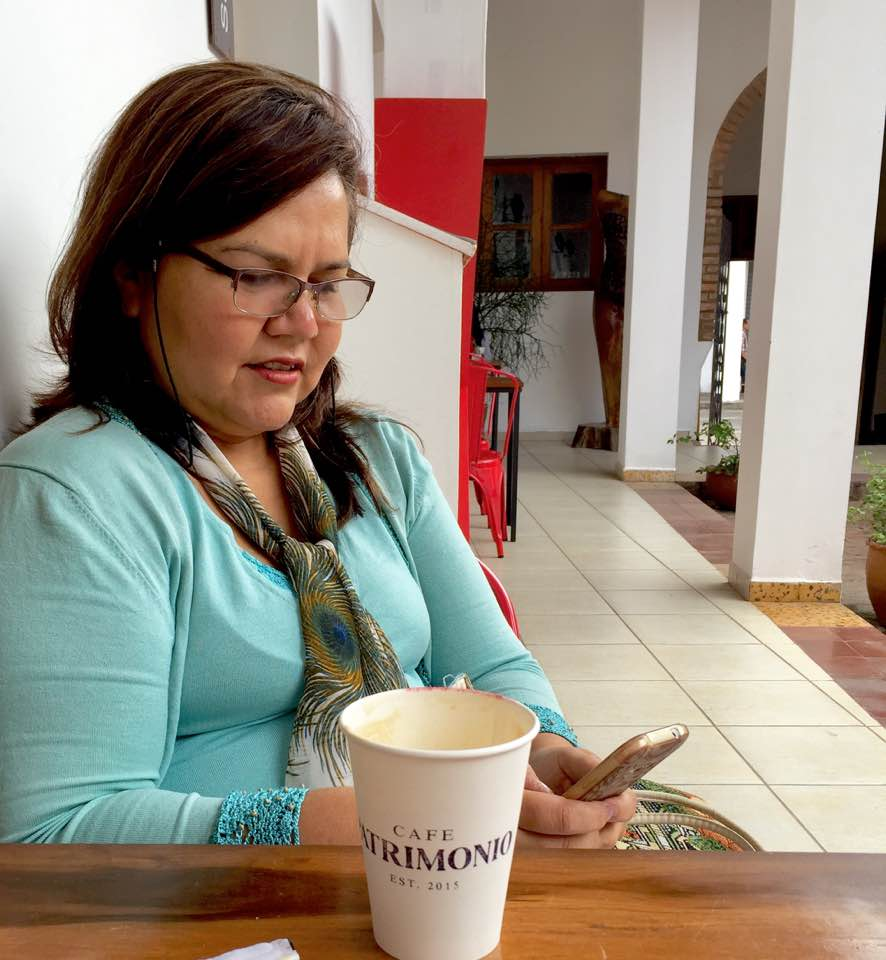
My friend, Martha, says she has friends there and thought we’d like to meet each other. So I invited her to coffee at my artsy coffee place near the Plaza, the CafĂ© Patrimonio. Since it is a new place, only since January, many of my Bolivian friends don’t know about it yet. That means I have the great pleasure of introducing it to them.
I arrived early, so I could write a bit. I am waiting on a friend who is editing Onesimus, so I have started working on three other novels. I believe one will surface in the near future for me to finish. One is the story of Moses and Pharaoh’s daughter, another is Luke interviewing Mary, and a third an expansion of an event in high school. Martha arrived before I got too far.
Martha is one of my favorite people in Bolivia. She knows the significance of her namesake in the Bible and is striving to be more like her sister, Mary, who sat at Jesus’ feet. She feels she is like the biblical Martha, but if you meet her, you will agree that she is more like Mary. She is the kind of woman who devotes herself to prayer. She will pray for you in a heartbeat.
Now let me explain the picture of Martha texting. No, she is not one of those people who texts while talking to you. She has a friend in Trinidad that she wants me to meet, thinking she will show me some of the special sites in the city. So, while we were having coffee, Martha proceeded to text her friend to set up the meeting. You don’t get to see the next scene of her beating me over the head with her chair for taking a picture of her texting (just kidding).
After coffee, I had the privilege of showing her around the Patrimonio. It was the home of Dr. Melchor Pinto, a famous doctor and politician. One room is a reconstruction of his office. The walls are covered with famous people from Santa Cruz. I knew very few, but Martha, knew many of them.
There are five other rooms filled with art. Most of it is modern. One room is permanent; I think it ight have been Dr. Pinto’s personal collection. The other four change ever few weeks. They stagger the changes in galleries, so it seems that every week there is something new.
Martha needed to go to the school to work in her room. I needed to pack. I love relaxed mornings like this with friends. Want to join me for a coffee?
Sunday, June 25, 2017
June 25, 2017 - La Guardia and Instagram
La Guardia and Instagram
A few years ago, my friend and teaching partner, Denise, encouraged me to join Instagram. I balked because all my 6th graders at the time were on Instagram posting selfies all day long. I wanted no part of that. Denise told me that Instagram was created as a place for photographers to share their photos and learn from each other. So I followed her advice, created an Instagram account, and started looking for photographers. A lot of my students found me and today make up more than half of my followers, but I have also encountered many amazing photographers from across the globe.
Many of these people follow me and we have since become friends, though I have never met them. I have friends I chat with sometimes from India, Nepal, Ecuador, Brazil, and I forget where else. I have many invitations to visit their countries, and they should beware, because I might just do that.
When I arrived in Santa Cruz and started posting photos from here, I gained at least 100 or more followers from Santa Cruz. One amazing photographer, santacruzdelasierraoficial, just happened to be the son of a lady I taught back in the 80s.
One girl, Stefany, posted a beautiful picture of a church. I wrote her and asked where it was. She said La Guardia, where some friends of mine live. La Guardia is on the route from Santa Cruz to Samaipata, so I started looking for the church. Last Saturday, when I went on the spur of the moment to Samaipata, I saw a miniscule sign pointing to the plaza. I knew where it was, so I vowed I’d go this week.
This morning I had two errands to accomplish before I went searching for that church. I needed coffee from the Café Patrimonio. I admit it, I have become addicted to a morning coffee. I also wanted to buy some new pillows for the bed. April and May have been very damp. The weather was cool enough that I slept with the windows open most night and rarely used the air conditioning. My pillows were not smelling too good from being damp so long. I was afraid if I washed them, they might not get dry for a month, if ever. So, I bought be two new ones for just $12!
Then I was off to find a way to get to La Guardia. I did something stupid, but not horribly so, just stupid. I wasn’t sure where to get a ride to La Guardia, but had a general idea, so I asked a taxi driver to take me there. It was only six blocks away!
I was the last one on the micro (a small bus) when it left. Half of the time the trip took was in the Ramada Market. I could have walked faster than we drove. Most of my trip was sitting next to this adorable kid, whose mom was teaching him his letters, as he traced them with his fingers. Thirty minutes later, with two dozen getting off at various places and two dozen getting on, we arrived in La Guardia.
There is not a lot on the internet about La Guardia, except that its population is around 50,000, that it is the 16th most populous city in Bolivia, and it is the fastest growing city in Bolivia. I suspect in a decade that you won’t be able to tell where Santa Cruz ends and La Guardia begins. Even today there is not a lot of countryside between the two. Basically, it is a stop along the highway running west out of Santa Cruz. The street where you get off the bus (actually the highway) is crowded, busy, and hectic, with stores, businesses, small factories, and a bustling market.
But a mere block away is a quiet, tree-lined plaza, with lots of benches and paths to stroll. On the southside is the church I was looking for. On the east two schools. Most of the time I was there I could hear high schoolers playing a fierce game of some sort. To the south are a few houses and a big restaurant I was told is only open on Sundays.
To the west was a restaurant. I was hungry, so I chose that for lunch. It was packed! I have been told that is a good sign of good food. This place did not disappoint. Almost as soon as I sat down, they served me a bowl of soup and boiled yucca. Before I finished the soup, I had a plate of chicken and rice in front of me. When I got the bill, it was only $2 (15 Bs.). So, let me figure this out. I paid $0.30 to get here by micro, and will pay another $0.30 to get home, and $2 for lunch. I’d say this is worth the trip and maybe a few more visits in the future.
I wrote most of this before lunch or during lunch. But while I was eating, a young man from Santa Cruz who follows me on Instagram, named Andres, starting texting me and chatted about my pictures in La Guardia. At the same time, he was posting pictures of Cotoca. Mind you, I don’t know him, except through his posts on Instagram. He wanted to tell me today that he is studying photography at the university, and that he studied my photographs to improve his own. What? I am an amateur! Yet, he likes my photographs. So, I have to go back to Denise and thank her for getting me on Instagram, so my pictures can be an inspiration.
A last note about this day. And this is my favorite part. I usually leave a tip. That was how I was raised. Meals, haircuts, whatever are supposed to be tipped. Things are cheap in Bolivia. Imagine some of things costing half of what you’d pay in the States. So it is not uncommon for me to tip 30% to 50%, because things are dirt cheap here, but that doesn’t mean the quality is less.
I mentioned that my meal was 15 Bs or $2, but I only had a 20 Bs. to give him. I gave him the money and left, assuming he’d figure out the 5 Bs. was a tip. I went to the middle of the plaza and did some writing, and continued texting Andres. About twenty minutes after I was gone from the restaurant, the waiter came out looking for me to give me my 5 Bs. I wouldn’t take it, explaining it was a tip. It turns out his name is Marcos, the name I go by in Bolivia. I told him I enjoyed his restaurant and would most definitely come back (I’m already thinking I will next week). He doesn't get tips. I think I might have been the first.
And that is what I want to leave you with. There are beautiful people all around us. We don’t know what influence we will have on their lives. Andres admires my photos. Who knows where that friendship will lead? Marcos, the waiter, just made a friend today. I can see him becoming a friend like the waiters at La Pascana. If we open up our lives to others, we can both be blessed, as I was today, and we can bless others.
Friday, June 23, 2017
June 24, 2017 - The Pharaohs of Exodus
The Pharaohs of Exodus
Most people will quickly tell you that the pharaoh of the book of Exodus is Ramses the Great. Where did that idea come from? You will assume it has been verified by archaeology. But I think you would be surprised by the answer.
If you were raised in church, like me, you will know the stories of the Exodus. A pharaoh decides to kill all the Hebrew boys. One family hides their son, who is discovered by a daughter of pharaoh. She raises him as her own. Later that boy flees the country, only to encounter God. He returns to tell a new pharaoh that he is taking his people out of the country. That pharaoh refuses, causing his country to suffer ten plagues that devastate the country. Once the Hebrews leave, they cross the Red Sea on dry land, with pharaoh’s army in hot pursuit. That army is destroyed when the sea goes back to its place.
You might not be aware but most of the idea that Ramses was the pharaoh of the Exodus comes from Cecil B. Demille’s 1950s production staring Yul Brenner and Charlton Heston. It also starred Yvonne DeCarlo as Moses’ wife. She later played Lily Munster! There have been scholars that believed he was the pharaoh of the Exodus, but Hollywood made it stick.
Two problems arise as to who the pharaoh is. First, he is never mentioned by name in the Bible. There is a reason for that. Pharaohs considered themselves to be god-kings. They were the bridge between their brother gods and the common people of Egypt. God is mentioned early in the book of Exodus, as Yahweh, or I am. The book of Exodus was never meant to glorify a man who called himself god, but was meant to do that for God. Moses purposefully never named pharaoh.
Second, most archaeology has depended on dating anything in the Middle East according to Manetho, who wrote a narrative of the kings of Egypt, going back thousands of years. The problem is his work is only found in copies that never tried to be faithful to the original, so we don't know what the originals said. Many wanted to group kings in sacred “eights,” so kings were added that there was no evidence for just to complete the eight. Some of the pharaohs were given longer reigns than archaeology supports. His works also don't take into account that there were often co-rulers, two pharaohs. Yet evidence exists that pharaohs often placed their sons as co-rulers, just in case he were to die. So the length of time might be much shorter.
The Bible, as I discussed in an earlier blog, has proven to be the most historically accurate document in the ancient world. If we place the Bible in context of what we do know about the pharaohs of Egypt, the story is not only more interesting than Cecil B. DeMille, but also more exciting.
The pharaoh who ordered the execution of the Hebrew children was most likely Amenhotep I, who ruled from 1532 to 1511 BC. He was a busy king, invading what is now Sudan and Libya. He is probably best known for his daughter, Hatshepsut. It is also interesting to note that most of the pharaohs of this dynasty had “Moses” as a part of their name. It is not a Hebrew name, but very Egyptian. It seems to have been popular at the time.
Hatshepsut is most likely the daughter of the pharaoh mentioned in the book of Exodus. She was probably about 15, or younger, when she discovered and adopted Moses. That would be the reason she sought someone out to nurse Moses. It seems she was the only surviving child of her father, Amenhotep, and mother, Ahmose, making her important in the palace hierarchy. When her father had no son to follow him on the throne, he made Hatshepsut his heir. The plan would have been for her to have a husband one day who would become pharaoh.
Why do people never question why Pharaoh's daughter suddenly had a son? Why was she exempt from breaking a law protecting a Hebrew child? Why was Moses allowed to live? Because of her closeness to Pharaoh, she could break the law and bring a Hebrew boy marked for death into the palace. Her father, not wanting to lose his last child, permitted her to adopt Moses.
Her father married her to her cousin, or possibly half-brother, Thutmoses II, but they never had any children. Because of her preeminence, as being the child of the pharaoh and queen, when her father died, she co-ruled with Thutmoses. They co-ruled for many years after the death of her father, but she was most likely the one who actually ruled. Many who study Egyptian history note that she was one of the great rulers of this period, improving the infrastructure and enjoying a period of peace. It was possible that her adopted son, Moses, would succeed the throne, but Thutmoses II took a second wife who bore a son, Thutmoses III, about the time Moses was 30. So now, Moses was out of the picture. You can begin to imagine the palace politics of this family.
Thutmoses II died and Thutmoses III was promoted to pharaoh, even though he was still a baby. There was probably a lot of politics involved that eventually drove Moses away from court, leaving his adopted mother abandoned. Twenty-one years later, she died, and some historians suspect that she was poisoned. Thutmoses III commenced to get rid of everything that had to do with his step-mother. He must have hated her. Since Egyptian records were written in stone, he had her name and image chiseled out of every monument possible.
Records show that he was a powerful king. He expanded Egypt to the south, farther than any had gone before, as well as to the edge of Palestine and to Libya in the west. Then in the 39th year of his reign, his adopted half-brother arrived back in Egypt. The rest you know from the Bible.
History shows that he left Egypt a devastated land.
Isn’t that more exciting the Hollywood’s version?
This is also the basis of a novel I am writing. I'm not sure when it will be finished. But in the meantime, my novel Onesimus will be out soon.
Subscribe to:
Posts (Atom)
July 8, 2017 - Monte Blanco
Monte Blanco Imagine sitting on a hill, under the blue skies with green farmlands stretched before you, surrounded by the hills of the ...
-
Monte Blanco Imagine sitting on a hill, under the blue skies with green farmlands stretched before you, surrounded by the hills of the ...
-
The Indigenous People of Chuquisaca When in Santa Cruz, you experience the vibrant cosmopolitan life centered on commerce. It is as fas...
-
The Chiriguano Statue The Chiriguano is a frightening statue on the rotunda of the Second Ring and the Avenida Grigota, which passing...